
Sat Sangat Yoga Development Training - Level 1
Sat Sangat Yoga Development Training - Level 1
Course Fee: R13,500
Venue: Online Live
Participant Limit: 20
Module Format: 2 weekends in a month, four months out of 12 with an interval of approximately two months in between modules.
Course Dates:
- February 6-8 2026
- February 20-22 2026
- May 1-3 2026
- May 22-24 2026
- July 31 to August 2 2026
- August 14-16 2026
- October 30 to 1 November 2026
- November 13-15 2026
Course Introduction:
Deepen your understanding of the Yoga Sciences to enhance your self-healing process and to open the journey to becoming a yoga teacher or yoga therapist, if this is your desire. Itta Roussos leads certified, structured, and modular courses for level 1 and 2 Yoga development training; level 3 is Yoga therapy training.
Sat Sangat Yoga Development training focuses on imparting a broad set of skills and knowledge about the science of Yoga. Level 1 is an introduction to practicing or sharing the teachings of Yoga therapeutically, bearing in mind that many people who would like to practice Yoga have mixed health conditions, which can be anything from lower back pain to autoimmune diseases and mental health conditions. In the training we examine contraindications, cautions, and the application of modifications to yogic practices suitable for conditions of health and wellness that are controlled and under medical supervision, or are not critical enough to warrant this level of care.
Level 1 Yoga Development training is a self-healing process where we examine the many aspects of the self which retard our spiritual growth. These aspects, carried over from previous incarnations we may have experienced, can collectively be called the ego, the lower self, or the finite self. This is contrasted with the higher, or infinite self, which is not subject to the wounding and conditioning received during childhood, adolescence, and adulthood, or the karmic load we have brought into this lifetime. We learn tools in level 1 which assist us in cultivating greater awareness of how the lower self acts out, and in growing the capacity to contain it’s impact and make better life choices. Level 1 is an in-depth process of self-study, using the tools of Yoga, for the purpose of spiritual growth and development. Becoming certified in level 1 qualifies you to teach the tools to others, if you wish, or to continue studying and growing your own spiritual capacity by going on to study the level 2 modules.
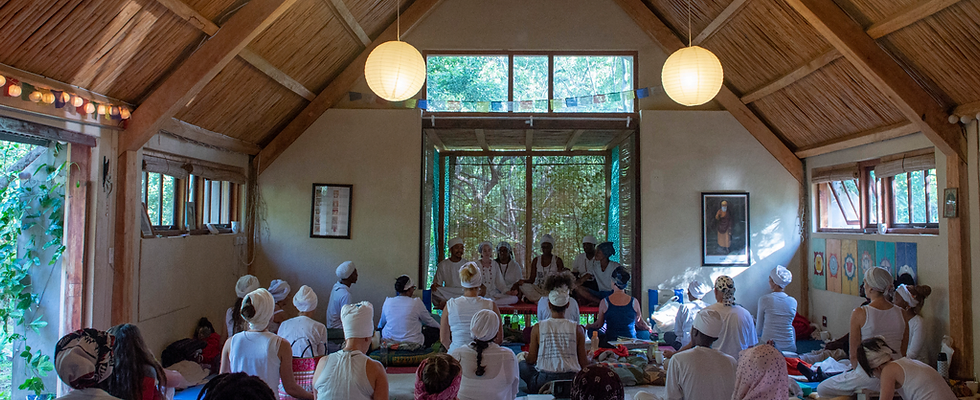
A further aspect of level 1 training is working in groups to gain real-time experience of how the lower self shows up when exposed to the group setting. Other nervous systems, subject to the play of the lower self, create responses in us that only emerge in the group context. We consciously examine and learn about group consciousness and how to grow the individual consciousness in this environment. The self-study component is greatly enhanced by this carry-over into real-life situations in real-time. The opportunity to learn how to cultivate and implement the higher self’s guidance, and to contain and transform the lower self’s activities is invaluable life-skills training for the outside world. This is unique to Sat Sangat Yoga Development training, and is carried through into level 2 and yoga therapy training courses.
Level 1 Yoga Development training does not qualify you to work with any illness other than your own, should this apply to you; at the stage of Level 1, you are qualified to recognise what is out of your scope of practice – should this arise with yourself, in your circle of contacts, or in a classroom environment – and to consult or refer these to a medical or Ayurvedic doctor, or a yoga therapist.
Level 1 is a feeder training for Sat Sangat school of Yoga Therapy. Should you wish to continue studying, you will have automatic entrance into the yoga therapy training provided you have achieved all the certification requirements for Level 1.
Itta Roussos, a certified yoga therapist with a Master’s degree in Psychology, has close to five decades of experience with teaching and practicing Yoga. Sat Sangat Yoga Development training, written and compiled by Itta, includes an introduction to Yoga philosophy, basic Ayurvedic knowledge, and an in-depth understanding of how asana, pranayama, mudra, bandha, mantra, and meditation practices impact on general health from the perspectives of Hatha Yoga, Tantra Shastra, and Kundalini yoga.
You will be trained in the application of these technologies with people who are at different levels of ability due to age, environmental differences, lifestyle, physical capacity, and stress levels. Training includes lectures, supervised teaching practicum, peer group work, teacher development, training videos, Q&A, and discussions.
There are four modules in Level 1 totaling 226 hours and covering the time span of one year. Attendance is online and mandatory. Completing the written assessment and other certification requirements is managed during the year after live attendance and must be completed in the space of 12 months, after the completion of all four modules. All certification requirements for Level 1 must be completed within two years.
Students are assessed through in-class practicum sessions which involves leading different types of yogic practices, personal practice at home in between modules, group work, and a written assessment on completion of all four modules. The process of learning on the training is integrative and requires individual and group practice in between modules.
The prerequisite requirement to enter Level 1 is a minimum of six months of personal practice and class attendance, and a recommendation from a qualified yoga teacher. Alternatively, an onboarding interview with the lead trainer can clear attendance on the training.
The cost for the modules is all inclusive.
If you would like to attend the Level 1 Yoga Development training, please fill in the form below. If you require a more immediate response please email itta.roussos@gmail.com
Certification requirements are as follows:
- Attend all Level 1 Training classes – 226 classroom hours.
- Participate satisfactorily in community building events and seva in own local communities or with existing Sat Sangat initiatives.
- Create a seva project or join an existing seva project bringing the teachings to others.
- Complete 20 Kundalini Yoga Classes with a certified Sat Sangat teacher after completing four modules.
- Perform satisfactorily in student teaching practicum.
- Create two acceptable yoga course curricula, one of 4 weeks and one of 6 weeks duration.
- Receive a passing grade of 85% on all assessments.
- Complete the assigned 40-day daily practice in between modules.
- Submit a summary of journaling insights on each 40-day practice.
- Participate satisfactorily in all group work assignments.
- Participate in at least five full morning Aquarian Sadhanas of 2½ hours each.
Each module focuses on a different set of skills to fully step into “the Teacher” forcefield. “The Teacher” refers to an archetypal energy that must be released and given permission in each person. It does not necessarily imply becoming a Yoga teacher, although this is possible should the desire be present; it is about enabling an inherent power in each person to align with the forces of Nature. Every module trains a different aspect of the individual to enable this energy to unfold and expand internally. This energy guides and shapes our lives for the greatest expression of our highest selves.
Level 1 Sat Sangat Yoga Development Training Outline:
Each module in the Level One Sat Sangat Yoga Development Training has basic foundational aspects that form part of all four modules. These are all encompassed in an understanding of how to use the tools and technologies of Yoga to build global spiritual community and create group consciousness which emphasises implementing the Sat Sangat mission statement: “Social Justice is a Spiritual Practice”. Sat Sangat trains people in many parts of the world and the network broadens every year.
Other foundational aspects repeated in each module are:
- Svadhyaya/Self-study: the training includes written, oral, group, partnered, and individual exercises on increasing awareness of how the lower self acts out within the individual, and between the individual and the other person. The emphasis is on a neutral, compassionate, understanding of how to apply the teachings so that the guidance from the higher self is heard and implemented.
- Practicum: each student is given an opportunity to practice teaching a kriya or meditation either individually (in later modules) or in teams in their earlier modules.
- Feedback on practicum: the lead trainer takes the opportunity of feedback to examine the kriya and explain how to teach to mixed health conditions so as to prevent any harm to students. The lead trainer is a qualified yoga therapist and explains some basic principles of yoga therapy to be applied when practicing personally, or when teaching a yoga class to people who may not be fully healthy. As many people these days seek Yoga to improve health conditions, this applies universally.
- Kriya Analysis: the kriyas that form part of Practicum are chosen carefully to match the topics of each module. During Kriya analysis, the lead trainer uses many years of experience practicing and teaching the kriyas to bring in Yogic philosophy and how it relates to the movement of subtle energy.
- Subtle Anatomy: each module expands on a particular aspect of subtle anatomy and expounds on how it fits into the cosmology of Yoga. Kriyas and meditations are selected that illustrate these aspects of subtle anatomy. Students get a deeper understanding of subtle anatomy through the lectures and then get an opportunity to experience it during the practical aspects of the training.
- Physiology: each module teaches some aspect of Western anatomy and how each relates to subtle anatomy. Kriyas are used as practical examples of how physiology is impacted by the movement of inner energy that is involved in subtle anatomy.
- Mantra and the science of sound: each module works with different mantras and examines their meaning and impact on physical and subtle anatomy, and which lineage of Yoga the mantras belong to, how they tie in with each other, their differences and similarities and how they relate to yogic philosophy as a whole.
- Philosophy: each module works with an aspect of Yogic Science and how it fits into Sankhya Yoga, which is the school of Yoga from which all physical and philosophical practices and concepts that are used in the training are derived. This is also compared and contextualised to scriptural texts such as the Upanishads and the Vedas, and writings coming out of Tantra Shastra and Hatha Yoga.
- 2.5-hour meditation: each module concludes with a 2.5-hour meditation that highlights many of the philosophical and practical aspects studied during the kriya. The meditation is introduced and led by the students who form a group guided by the current graduates who are completing their fourth module.
- Homework: each module requires of the students to complete a forty-day practice that comes out of the practical and philosophical aspects of the module. Students must journal their experience and they are encouraged to practice as a group. This builds a sense of companionship and compassion in the group and assists each person to complete their certification requirements in the context of the group.
- Silence: students are encouraged to practice silence for some parts of the training so as to develop an understanding of the power of this tool.
The particular topics taught in Module One bring students to an understanding of their very human complexes, belonging to the finite realm of the ego, and how to work with these in order to aim their efforts to the end goal of Yoga, to express their infinite Self in all aspects of daily life, not just in the studio or on the mat. Inner silence is taught as a modality of meditation to increase inner stillness as a point of internal contrast to the noise of the ego complexes that relate to each person’s individual karma. The concept of “the Teacher” as a forcefield of energy or an archetype of the cosmic power is introduced, and students begin to understand the journey to being shaped and moulded by this cosmic power. The identity of a Teacher “with a capital T” are examined along with which aspects of this they would be most likely to find challenging individually and in groups.
The unique topics in Module Two centre on a study of the mind as a tool of the Divine and our greatest obstacle to spiritual growth. Kriyas and meditations are chosen to illustrate how to use the mind to gain control over it, which paradox is central to Yogic teachings. Students are encouraged to learn how their own minds control them and keep them repeating old habit patterns of thought, speech and behaviour.
Relaxation, or shavasana, is studied as a powerful tool to gain control over the mind. It is understood as an advanced form of concentration and the benefits and practices of Yoga Nidra are studied. The thread of how to use these philosophies and practices to enhance the expression of the Teacher is woven into this module as well.
Module Three works on the concept of Nobility, and how to express this out in the world. Patanjali’s Sutras and Ashtanga Path of Yoga is studied and related to the inner archetypal power of Nobility. Naad Yoga and the science of sound forms a central part of this part and how to use Shabd, or the Divine sound current, to cut through negativity and obstacles to the cultivation of inner Nobility.
Students are always encouraged to individualise the teachings and relate them to their personal challenges and obstacles. The safety of the group container is emphasised and built so that students understand the value and practicalities of holding space for each other to explore their most vulnerable life experiences. The lead trainer ensures a thorough understanding of how to do this.
Yogic diet forms an important part of this module and students are taught what that means and how to gently nurture themselves into incorporating more of these aspects into their daily lives. Eating disorders are addressed and students are taught how to address this in themselves should this be an aspect of their lives. Many people have traits of an eating disorder and examining this in the context of the training has assisted many students to recognise this and to begin to heal it in themselves.
The relationship between student and teacher is also examined in this module in relation to the ethical constraints that apply to this relationship. The roles and responsibilities of the teacher inside and outside the classroom are an important part of learning to develop the archetypal energy of the teacher within.
Module Four looks at decolonising Yoga and how to bring the ethical concepts of Yoga (yama and niyama) to life with regard to real world situations. Students are encouraged to think about cultural appropriation and how to avoid this. The use of social media is examined and students are taught how to apply the yamas and niyamas to their decisions about earning a living, having a relationship, and conducting roles that are required in their daily lives. The science of breath is studied in this module. Pranayama and how it impacts subtle and physical anatomy is an important part of this module. The solar science of Yogic practices is expounded and students study mantras that utilise solar science to ignite the inner light. This module also examines how to use asana correctly as one of the components of the eight limbs of Yoga.
Final words:
Group work is an integral part of the training. The development of group consciousness is part of the training and students are assessed on their capacity to work together on community projects and coursework. The experience of group consciousness is transformative. It creates a greater depth of understanding of the healing potential using the technologies and practices than is possible in an individual format. The online format is impactful as a way of making the training accessible to people from all parts of the world. The diversity of outlook and experience makes for a powerful container of learning.